Key takeaway:
• Concrete drilling creates precise holes for plumbing, electrical, and HVAC penetrations and requires scanning before any cut is made.
• Silica dust control and service location are the two biggest safety priorities on any job site.
• Professional operators use scanning technology to locate hidden pipes, conduits, and reinforcing steel before drilling begins.
Concrete drilling is the process of cutting precise, round holes through concrete slabs, walls, or beams to allow pipes, cables, or conduits to pass through. It is a routine but technically demanding task used across residential, commercial, and civil projects wherever a controlled penetration is needed rather than a rough break-through.
Most drilling jobs fall under a small number of use cases. Concrete Drilling is most often requested for plumbing and drainage lines, electrical conduit runs, and air-conditioning installations, where a clean, accurately placed hole prevents damage to surrounding structure. Civil and mining projects also rely on core drilling for anchor points, sampling, and service installations that need to match tight tolerances.
Why Scanning Comes Before Any Drilling Work
Locating what lies beneath the surface is the first and most important step in any concrete penetration job. Hidden electrical cabling, post-tension cables, plumbing lines, and reinforcing steel can all be damaged if a hole is drilled blind, leading to costly repairs or safety incidents.
Ground-penetrating radar and electromagnetic scanning are used to map these elements before cutting begins. On verified Nova-Cut projects, this step is described as locating hidden pipes, electrical conduits, and reinforcing steel before the drill bit is ever applied, which helps prevent damage to services and avoid unnecessary repairs.
Standard pre-drilling checks typically include:
• Scanning the intended drill path to a depth that covers typical slab and wall thicknesses
• Marking confirmed service locations before any equipment is positioned
• Reviewing site drawings where available to cross-check scan results
• Confirming disconnection and tagging of any service that must be cut through
Managing Dust, Noise, and Site Safety
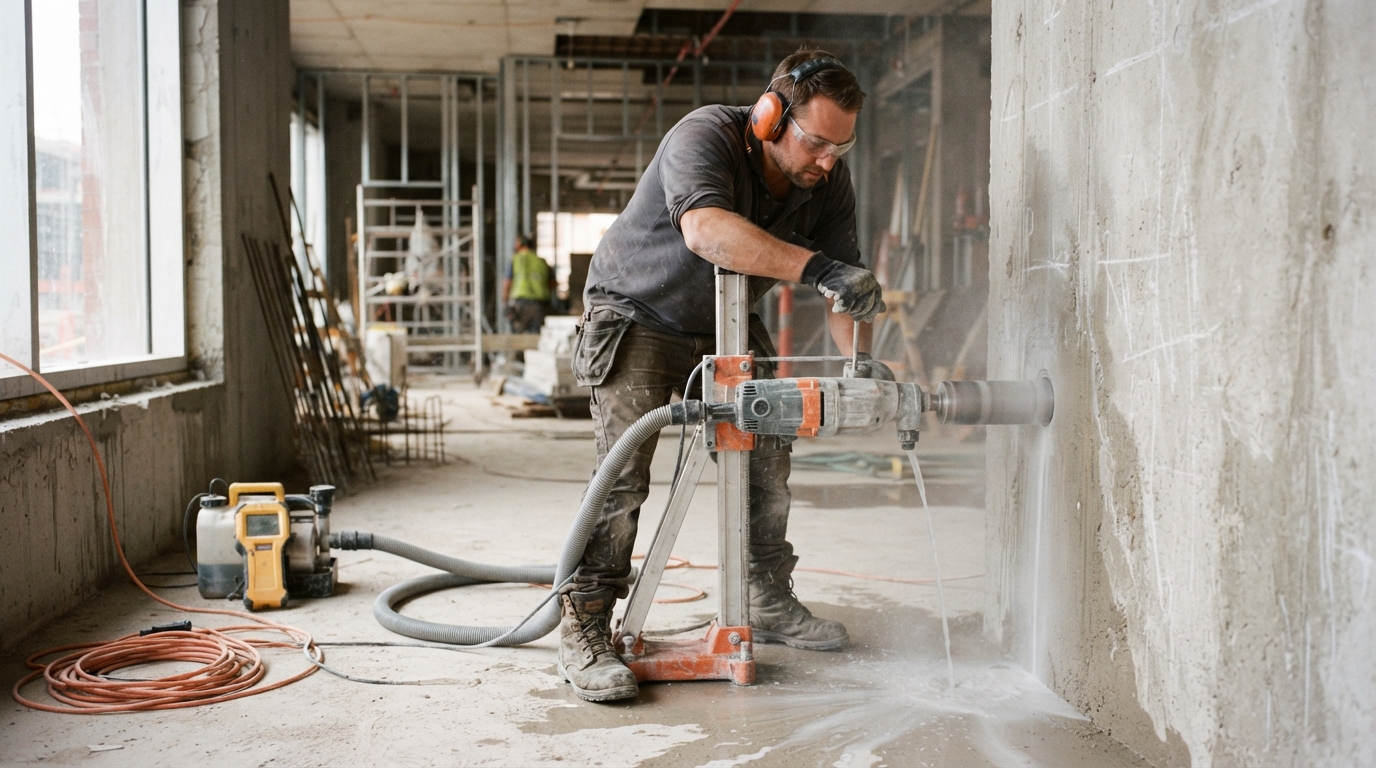
Concrete drilling generates fine particulate matter known as respirable crystalline silica, which poses a long-term health risk if inhaled without proper controls. According to SafeWork NSW guidance on cutting, drilling and grinding concrete, concrete core drilling involves cutting circular holes and removing cores to allow for services such as electrical work, and risk controls need to be applied consistently across the task.
Wet drilling methods, which introduce water at the cutting point, are a common engineering control used to suppress dust at the source rather than relying solely on respiratory protective equipment. Other core safety measures on a drilling site include:
• Securing the drill stand or mast to the work surface before operation
• Establishing exclusion zones to keep bystanders clear of the active work area
• Covering or marking completed penetrations to prevent slip and trip hazards
• Using hearing and eye protection given the noise and debris generated by core drills
These controls matter particularly in built-up areas such as Newcastle, NSW, where drilling often takes place on occupied residential or commercial sites with people working nearby.
Comparing Drilling Methods for Common Applications
|
Application |
Typical Hole Size |
Primary Consideration |
|
Plumbing and drainage penetrations |
Small to medium diameter |
Must avoid existing pipework and follow fall gradients |
|
Electrical conduit installation |
Small diameter, precise placement |
Requires confirmed de-energisation before cutting |
|
Air-conditioning fitouts |
Medium diameter, wall or slab |
Needs clean edges for sleeve and seal fitting |
|
Civil and mining applications |
Larger diameter, variable depth |
Structural assessment and reinforcement scanning critical |
Based in Cardiff, NSW, Nova-Cut Concrete Sawing Pty Ltd carries out drilling and sawing work across Newcastle, NSW, covering jobs that range from single residential penetrations to larger civil projects. The company’s documented service list includes core drilling alongside road sawing, wall sawing, floor grinding, and concrete scanning.
Frequently Asked Questions
How deep can a concrete core drill cut? Core drilling depth depends on the bit diameter, the drill rig used, and whether the application is handheld or mast-mounted; civil and mining jobs typically require larger, deeper cores than residential plumbing penetrations.
Is scanning always necessary before drilling? Scanning is standard practice because it identifies hidden services and reinforcing steel that could otherwise be struck during drilling, reducing the risk of damage or injury.
Can concrete drilling be done indoors? Yes, though dust control measures such as wet drilling or local exhaust ventilation are required to manage airborne silica dust in enclosed spaces.
What is the difference between core drilling and concrete cutting? Core drilling produces round holes for penetrations, while concrete cutting (such as wall or road sawing) creates straight-line cuts for openings, joints, or removals.
Final Notes on Planning a Drilling Project
Concrete drilling is a precise task that depends on accurate scanning, appropriate dust and noise controls, and equipment matched to the job’s scale. Getting these steps right reduces the risk of service strikes, structural damage, and compliance issues on site.
Current service area information for Nova-Cut Concrete Sawing Pty Ltd is available for projects located within the Newcastle, NSW region.